Garden Decor Lighting Ideas: Lanterns, String Lights, and Fire Bowls
A practical guide to lanterns, string lights and fire bowls: how to layer decorative garden lighting for...

A small city garden has a lighting problem that is mostly a geometry problem. Six square metres of courtyard, walls on three sides, a kitchen window looking down on all of it — there is nowhere for light to go but straight back at you. The instinct is to add more fittings. The better answer is usually fewer, placed higher, aimed sideways, and bounced off surfaces that are happy to hand the light back.
Everything below assumes three things: you want a garden that looks good from the sofa as well as from the path, you would rather not blind the neighbours, and you would like to finish the job over a couple of evenings rather than a fortnight of trenching.
A garden needs three jobs done after dark. Ambient light so the space reads as a room rather than a void. Task light where people actually move — a step, a gate latch, the door threshold. And one accent that gives the eye somewhere to rest, usually a plant, a tree trunk or a textured wall.
In a large garden those are three separate systems. In a courtyard, a single well-placed fitting often covers two of them. A wall-mounted downlight above a step lights the route and washes the wall behind it. An uplight in a planter lifts a shrub and throws a soft pool of light onto the paving.
So write the list, then halve it. Most small gardens end up with twice the fittings they need and half the thought. Before you buy anything, take a torch outside after dark and hold it at ankle height, then waist, then head height, then against the wall. Ten minutes of that will teach you more than a catalogue will.
Horizontal light on a small plot just shows you how small the plot is. Light aimed across a wall makes the same space feel taller and pushes the boundaries back. This is the single most useful trick for courtyards and narrow side returns.
Mount a shielded downlight roughly 1.8 to 2.2 metres up a wall and let it graze the surface. On brick, render or slatted timber it picks out texture you never notice by day and lays a soft scallop of light on the paving below. Uplight a climber, a small tree or a tall grass and you get a vertical accent without eating any floor space at all.
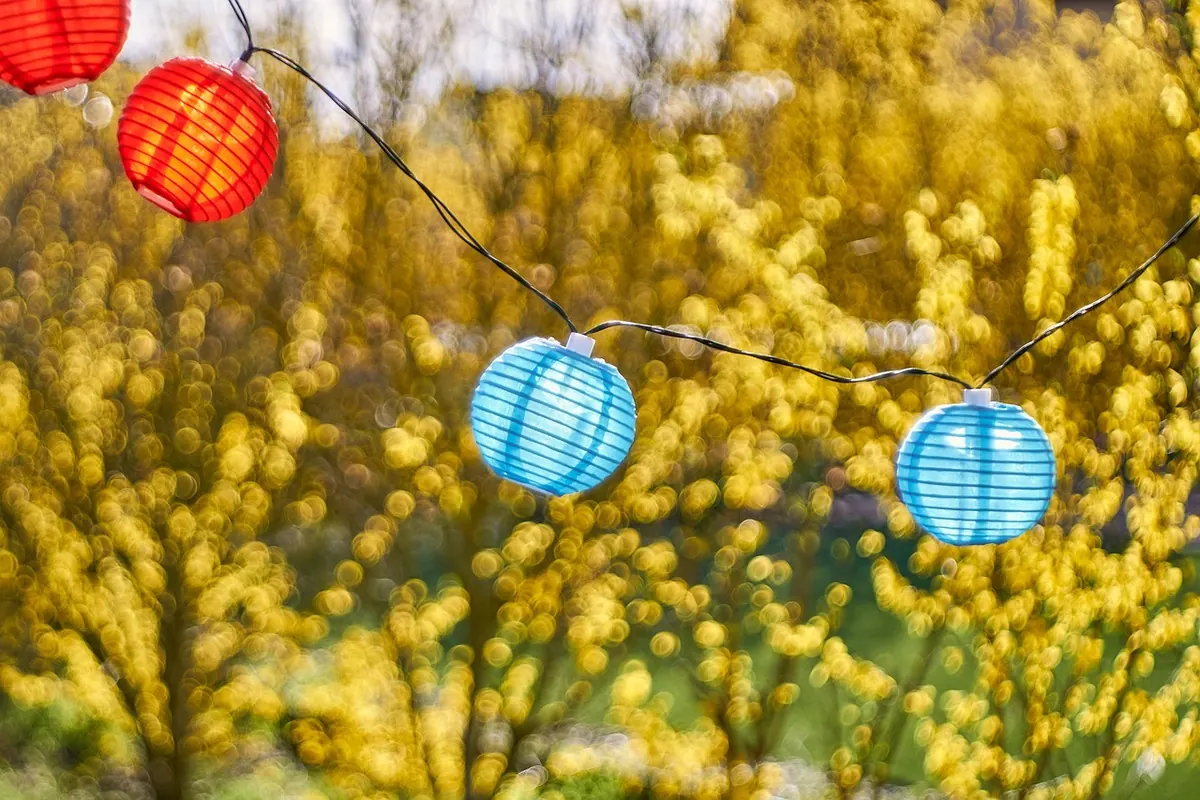
Hanging lanterns, pendant fittings on a bracket and string lights strung between two hooks all use air rather than ground. Stagger the heights so the eye travels. Keep string lights high — above roughly 2.4 metres — so people walk under them rather than through a glowing curtain. And always angle or shield the fitting so the beam falls inside your boundary; a fence-top light that spills into a neighbour's bedroom is the fastest way to sour a good relationship.
Space-saving lighting is mostly about buying objects that were going to be there anyway and giving them a second job. A few that earn their footprint:
Pick a single finish — matte black, bronze, anthracite — for everything you buy. Consistency makes a handful of fittings look like a scheme, and dark housings disappear against planting and fencing.
You are not only installing light; you are choosing what it lands on. Pale stone, gravel, lime-washed walls, light timber and brushed metal all reflect a useful amount of light back into the space. A bag of pale gravel along a path can lift the whole courtyard for very little money.
Reflection is where small gardens can cheat. A narrow run of wall can be doubled with an exterior-grade mirror panel at the far end. A shallow bowl of water, a glazed pot, a polished concrete table top or a stainless water feature will each pick up a warm lamp and throw it about. Aim a fitting at a reflective surface and the light arrives twice.
A good small-garden scheme is judged by what you can see, not by what you can see the light coming from.
One caution: glossy surfaces and bright fittings do not always mix. A dark polished tile directly under a downlight becomes a mirror of the lamp itself, which reads as glare rather than atmosphere. If a surface is shiny, light it from an angle or from further away.
Every freestanding path light in a courtyard is something to trip over, mow around or knock with a watering can. Recessed deck lights, step nosings and in-ground markers set 30 to 40 centimetres back from a path edge all keep the walking surface open.
The rule that matters most: light sources should sit below knee height or above head height, never at eye level. A bollard of 40 to 60 centimetres with a louvered or shielded head directs light downward where it is useful. A bare lamp at 1.5 metres simply stares at you across the patio and ruins the effect of everything else.
Check heat as well as glare. A fitting that sits in the walking line of a barefoot summer evening should be an LED that stays genuinely cool in the housing — test it with your hand before you commit.
Keep the colour of the light consistent. Something in the region of 2700K to 3000K, warm white, across every fitting you install. One cool-white lamp in a warm scheme is instantly visible as a mistake, especially against foliage.
Then make the whole thing adjustable. Two circuits is the ideal — one for the path and door, one for the mood lighting — and both on a timer or smart plug so the garden lights itself and you never have to remember. Run everything dimmed to around two-thirds of full output; in a small space, restraint reads as design.
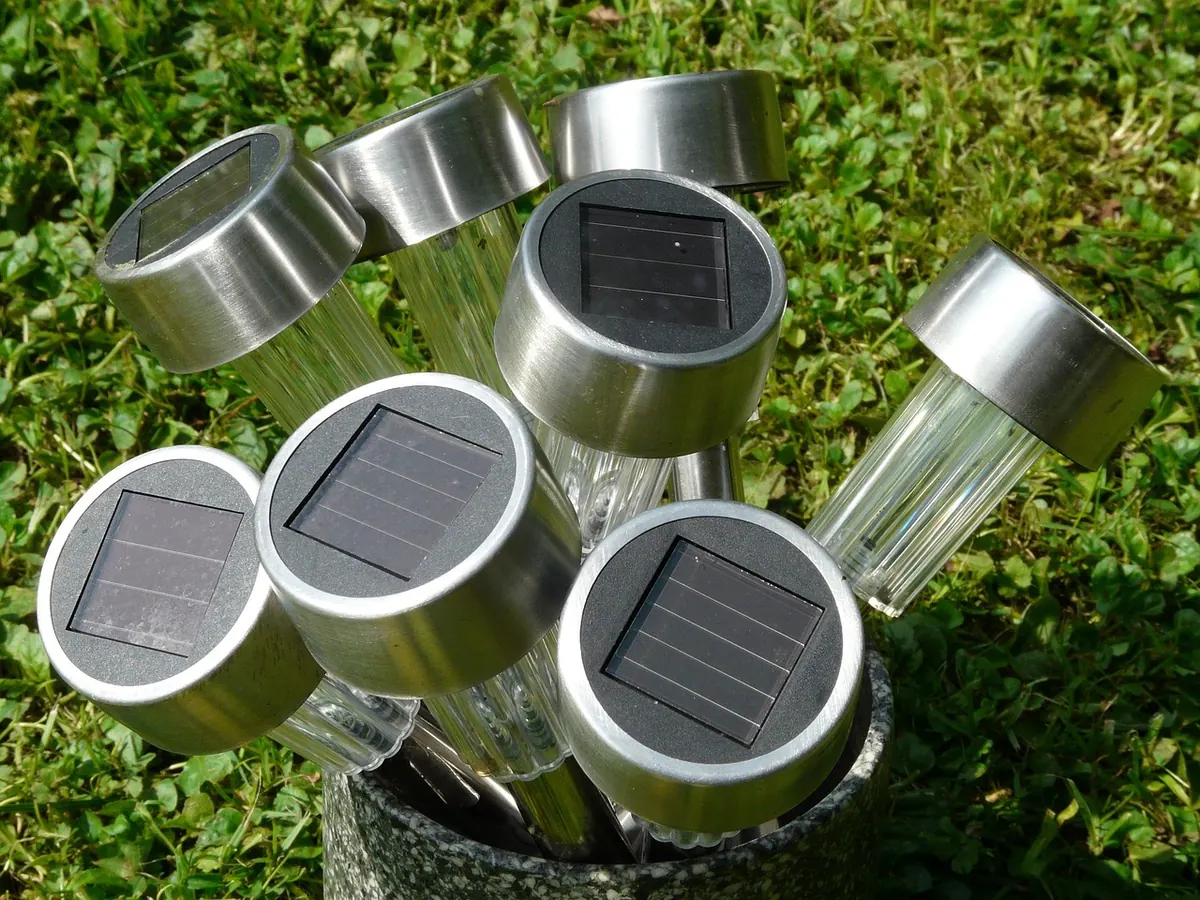
For outdoor work, look for fittings rated at least IP65, and higher for anything that will stand in water. Low-voltage kits are widely available and easy to extend, but they still need a proper transformer in a dry housing, and anything connecting to mains supply should be installed and checked by a qualified electrician in line with local rules. Hide cable along the base of a fence, beneath gravel, or in conduit painted to match the wall. Solar fittings have their place — a shed, a rented courtyard with no wiring — but they need direct sun to perform, so test one before buying six.
A small garden does not need to be brightly lit. It needs two or three deliberate pools of light, a hint of texture on the walls, and enough darkness between them for the lighting to mean something. Get that right and six square metres will feel like considerably more.
Photo: glacika56 / Pixabay
A practical guide to lanterns, string lights and fire bowls: how to layer decorative garden lighting for...
Practical ways to conceal garden lights, transformers and cable runs using planting, mulch and edging — so...
Solar and low-voltage garden lights differ most in wiring, upfront cost, and how steady they stay through...